
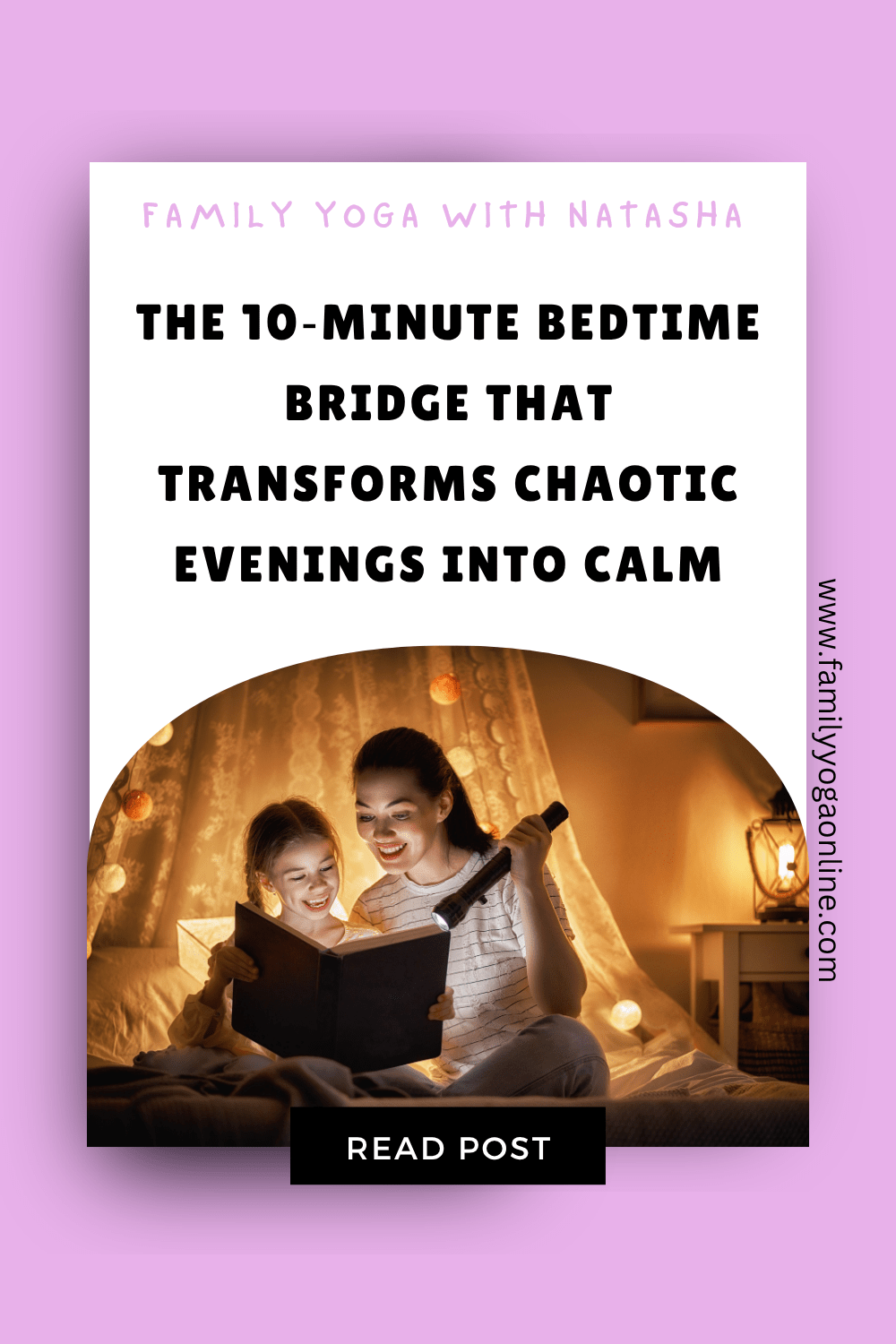
Because stressful nights don’t need to end in battles (or guilt).
Real Talk: Messy Bedtimes Happen
Let’s be honest… I am not the mum who has her evenings perfectly organised, where the kids calmly go to bed at 7 p.m. and I get this magical “me time” after. Nope. Sometimes it’s 9 p.m. and no one’s in bed. Sometimes I got distracted, or dinner ran late, or everything just felt… too much.
And that’s okay. Bedtime chaos doesn’t mean you’re failing. It means you’re human.
What I don’t want to give you is another impossible bedtime routine to nail. You probably already know the basics…. the bath, the story, the lights down. What I want to show you is something different: a bridge that gently carries your child (and you) from busy and restless energy into rest.
Why Bedtime Feels So Hard
Bedtime is a transition… and transitions are big. We ask our kids to go from movement and stimulation to stillness and sleep within minutes. Yet their nervous systems (and ours) can’t always shift gears that fast.
Some children bounce between excitement and anxiety: they talk, fidget, stall, or beg for “one more thing.” Others spiral into worry. And for us parents, after a full day, those moments are where patience disappears.
The truth is, bedtime challenges are rarely just behavioral. They’re physiological. Our bodies are simply too activated to settle. That’s why I created the three‑part bedtime bridge — a simple, 10‑minute ritual that helps everyone cross over into calm.
“The bridge helps the body catch up to what the mind already knows — it’s time to rest.”
The Bedtime Bridge: Connection, Movement & Breath
You can add this mini‑ritual after your usual bedtime routine (or chaos) or on its own. It takes about 10 minutes and blends emotional, physical, and nervous‑system support. Nothing rigid or complicated.
Let’s walk through it.
Step 1 — Connection: Talk, but intentionally
Spend a few minutes simply being with your child. If they need to talk — let them, but guide the space. Sometimes it’s gratitude (“What went well today?”) or a highlight reel. The goal is to offer presence, not therapy.
Validation matters…..yet endless late‑night processing can actually feed anxiety loops. Five minutes of focused connection helps them feel heard without spiraling into over‑talking.
“We don’t have to solve everything tonight. Safety comes first — through presence, not perfection.”
Step 2 — Movement: Let the body join in
Once thoughts feel lighter, shift to the body. Movement brings the nervous system into the moment.
Try:
- Legs up the wall — simple, grounding, playful.
- Balancing a teddy or block on their feet for giggles.
- A gentle shake‑out if energy’s still high.
This step isn’t just for your child — it’s co‑regulation. Your body settles with theirs. You’re showing, not telling, what regulation feels like.
Step 3 — Anchor the Breath
Now that mind and body are connected, end with breath. Keep it simple.
My go‑to:
“I am breathing in. I am breathing out.”
Repeat slowly. Words become an anchor, helping thoughts drift away.
Another favourite, especially for kids — is balloon belly breath:
- Breathe through the nose.
- Fill the belly like a balloon.
- Slowly “pop” it as you exhale.
Encourage long, gentle exhales — that’s where the magic happens. For younger ones, make it playful: bigger pops at first, then softer, slower ones.
For teens or adults, we can try a more advanced technique where we are lengthening the exhale like in for the count of 4, out for 6 or 4‑7‑8 (Inhale 4, hold for 7, exhale for 8) to bring deeper relaxation. But I don’t do these breath holds with younger children, and honestly, just an awareness is a great place to start.
Rest Isn’t Just a Bedtime Job
Here’s what I wish I’d realized sooner: rest can’t wait until 9 p.m.
When we carry stress all day, expecting bedtime to fix it is unrealistic. Our systems need smaller rest pauses sprinkled throughout — tiny practices that reset our baseline before the evening chaos.
Mini‑rest ideas:
- Five minutes of legs‑up‑the‑wall after school or work
- A playful yoga game before dinner
- Family breathing practice between activities
- Mindful colouring together
You’re training your collective nervous system to downshift sooner, so bedtime isn’t a crash‑landing.
Building Rest Into Daily Life
Inside The Family Yoga Club, we weave rest and connection into the rhythm of the day…. not just the nighttime rush. Through tools like yoga nidra and other Soma/moon practices, and playful co‑regulation, families learn the art of active non‑doing and being fully present without needing to fix or force calm.
These are the micro‑moments that re‑teach our bodies what safety feels like.
“We calm together first — and that’s what makes self‑regulation possible later.”
A Gentle Reminder
Your bedtimes might still look messy. Kids might pop out of bed. You might forget the bridge for a few nights. That’s all okay.
The point isn’t perfection…. it’s intention. When you build rest into your rhythm and practice the bridge — connection, movement, breath — you’re rewiring bedtimes from chaos into calm.
🌕 Final Takeaway
The bridge isn’t another parenting technique; it’s a nervous‑system invitation to feel safe, cosey and connected -together.
Start there. Ten minutes is enough.
💫 Join The Family Yoga Club
Your calm journey continues inside
👉 The Family Yoga Club on Skool
Get the free Family Calm Starter Kit, join the 30‑Day Calm Explorer Challenge, and explore playful yoga, nervous‑system care, and co‑regulation practices for parents and kids.
Let’s build calmer evenings, and calmer days- together.

I don’t always want to practice Yoga with my Children
This might surprise you, especially coming from someone who talks about yoga together sooo much, but I don’t always want to practice yoga with my children. And sometimes… they don’t want to practice with me either. The other day, I rolled out my mat ready for my own practice. And like a moth to a…

Why “Just Take a Deep Breath” Often Doesn’t Work (And What Actually Helps)
“Take a deep breath.” It’s one of the most common pieces of advice we hear…. to support children and ourselves, told to anyone who looks overwhelmed, angry or having a tough time. And while it’s usually said with care, compassion, and good intention… it so often falls flat. You’ve probably seen it.You suggest a deep…

3 Cosy December Family Practices
December starts tomorrow and I feel like November was just this blur…it went by so quick. I went from feeling super prepared to feeling like everything was on top of me and I started getting really overwhelmed. Every time I made time to step onto my mat and do my self-care practices, I could feel…
 Family Yoga with Natasha
Leave a comment