I know what it’s like to have a child who struggles with calming down. One thing that can be quite hard is when someone is playing around with him and he gets riled up and hyperactive but then they decide they’ve had enough and my little one still has all this energy and is not ready to stop. This transition alone can be a tough one.
Other transitions can be challenging too so we’ve found a mix of playfulness and calming practices really help to support him so things don’t turn into a big tantrum or meltdown.
For my older child the struggle in calming down comes down to struggling to calm their mind. Anxiety often makes itself known and so when we are talking about calming practices here, it’s all about helping them to calm their mind, ease anxiety and manage stress.
Calming down can mean different things in different circumstances but it always comes down to supporting the child where they are and helping them create this calm. Forced calm is not the goal.
Sorry but calming down is not about sitting down and shutting up.
So what is calm all bout?
Let’s look at this from the perspective of the Yoga Sutras.
The Yoga Sutras, were written over 1,500 years ago by Patanjali. They document the theory and practice of yoga. When we look at sutras 1.2 and 1.3 we can really dive in to what the purpose of yoga is. We can use this to help our own practice and support our children with calm.
The definition of Yoga by Patanjali is: Yogaś-citta-vṛtti-nirodhaḥ (Sutra 1.2)
We often see yoga translated as union but in the Yoga Sutras Yoga translates to:
Yoga is resolution of the mind’s activity, yoga is the cessation of the fluctuations of the mind.
Tadā Draṣhṭuḥ Svarūpe Avasthānam(Sutra 1.3)
And then, you can abide as your own true form.
So really what yoga is, is a way to attempt to discover or reveal what we already are or who we already are by bringing some calm to our mind.
As a family yoga teacher, I am deeply committed to guiding you and your child on a journey of self-discovery and inner clarity.
By helping clear the fluctuations of the mind, we empower children to navigate life’s challenges with resilience and grace. Through a combination of games, stories, songs, and movement with their supporting adult, children can explore their thoughts and emotions, uncovering the truth of who they are.
Yoga doesn’t have to look one way, it doesn’t have to used to ‘fix’ something within us, it doesn’t have to be practiced a certain amount of times…It can simply be a way to connect with ourselves and calm our minds.
And that is so needed, especially for children (and grown ups) that struggle with calming down and calming their mind.
With all that in mind, I would like to share 7 effective yoga practices for helping children to calm down and calm their minds.
Yoga Practices for more calm
1. I am breathing in. I am Breathing out.
One practice I often turn to myself is this simple breath technique with words to focus on like a mantra. Because of it’s simplicity and how quickly it can work, it makes it a good one to share with children. Simply saying to yourself, in your mind, “I am breathing in.” as you breathe in and “I am breathing out.” as you breathe out, helps to focus the mind on the present moment. Allowing everything else to settle. Racing thoughts can slow and you can just be present with the breath, with these words. It can help children tap into the present moment and create calm within.
2. Happy Elephant
For this practice we stand up tall, feet hip width or slightly wider and gently swing our arms from side to side. Let you arms be heavy and loose and let your knees bend and feet lift as get into this movement (you’ll feel what I mean when you try this, no need to overthink it). Basically swinging the arms side to side and letting them tap into your hips and just really letting go. Kid’s are so good at just letting go and embracing this one without trying to control it. You can see if they can go faster and faster and then we can slow it down and pause.
Pause in mountain pose, with hands down by the sides and just take a moment to notice. Do you arms feel tingly? How do your fingers feel? We want to encourage self-awareness here. We’ve had movement and now we’re exploring this stillness where we are just noticing sensations in the body. This is a great practice for helping your child with calming skills. Feel free to repeat this 2 or 3 times together.
3. Legs Up the Wall Pose
Legs up the wall pose is one of my favourite calming poses to practice with my children. Simply get as close to the wall as you can, facing to the side, and then lay back while pivoting your legs up the wall – as close as you can to the wall as possible. And no, there is no graceful way to do this, you may need to shimmy closer or grab some props like a blanket under your head.
We want to stay here for a few minutes and for a child who struggles with calming down and staying still, this may be hard, so here’s what you can do:
- Challenge them to balance a block or soft toy on their feet.
- Read a story here.
- For younger children you can sing a song – we used to sing
The Incy Wincy legs climbed up the empty wall,
We stretch them up high
Then we let them fall.
The incy wincy legs climbed up the wall again.
This time they’ll stay here until we count to 10!
(A song that came from (Possibly changed it slightly as it’s been a few years) by Itsy Bitsy Yoga for Toddlers and Preschoolers by Helen Garabedian)
You can even just play soothing music, or just chat together. Give it a try and see what works for you and your child. The more you practice, the longer you’ll be able to practice this for and even enjoy those moments of quiet too. Start small with a few minutes and then build up. For yourself, you can even practice this for 10 to 15 minutes, bringing your feet down into a diamond shape, feet together – knees apart, anytime you need a break.
4. Mindful Walk
Creating calm doesn’t mean staying still. Try going for a mindful walk together. What makes it mindful and not just a walk? Special focus is put on bringing an awareness to your surroundings and your senses. So often we walk and we are just so in our heads that we don’t even remember the walk. Ever had that? Where you’re just like oh wow, I’m here already or you just zone out – possibly listening to music or a podcast or phoning a friend.
For the mindful walk you want to notice the trees, maybe even run your hand over its rough bark. You could close your eyes for a moment and listen to the birds or other sounds. You could take your shoes off, if it is in a safe area to do so, and feel the grass beneath your feet – or maybe even sand if you were to go to a beach. The point is just to notice. Be in that moment.
A fun practice you can try if this is a struggle is to imagine that there is an alien in the sky and you have a walkie talkie to communicate with them. They have never seen Earth or anything on Earth and they want you to explain everything that you are seeing. How would you explain it to someone who doesn’t even know hat a flower is? This really encourages you to think about each detail from a fresh perspective.
5. Chocolate Meditation
This can be done with an apple, raisin or lollipop too just adapt as necessary and make sure to bring a focus to the senses. Take a square of chocolate that your child will enjoy (so if they don’t like dark chocolate, don’t use that as they will not be shy about spitting it out). If they feel comfortable closing their eyes, they can start there as you place the square of chocolate in their open palm.
- Ask them to notice how it feels in their hand without closing their palm.
- Open the eyes if they were closed and really look at the chocolate. It’s shape, the edges where it was broken off the bar. Any details.
- Turn it around in your hand, noticing how it feels and what it looks like from different angles.
- Smell the chocolate.
- Now place the chocolate on your tongue (or hold it on your tongue) without closing your mouth. Take it away again. Notice the taste in your mouth. Repeat one more time.
- Now place the chocolate in your mouth but try not to move your tongue, just keep it still in your mouth and again just notice.
- Now you can move the chocolate and notice how it feels on your tongue or you can just let it melt slowly.
- When it’s all gone, before rushing to do it again or finishing the rest of the chocolate, just pause. Bring an awareness to your body. How do you feel?
That is the end of the chocolate meditation. reflect on that experience together and if they enjoyed it, or what they enjoyed about it. Did it feel different to just eating the chocolate as they normally would?
6. Tree Pose
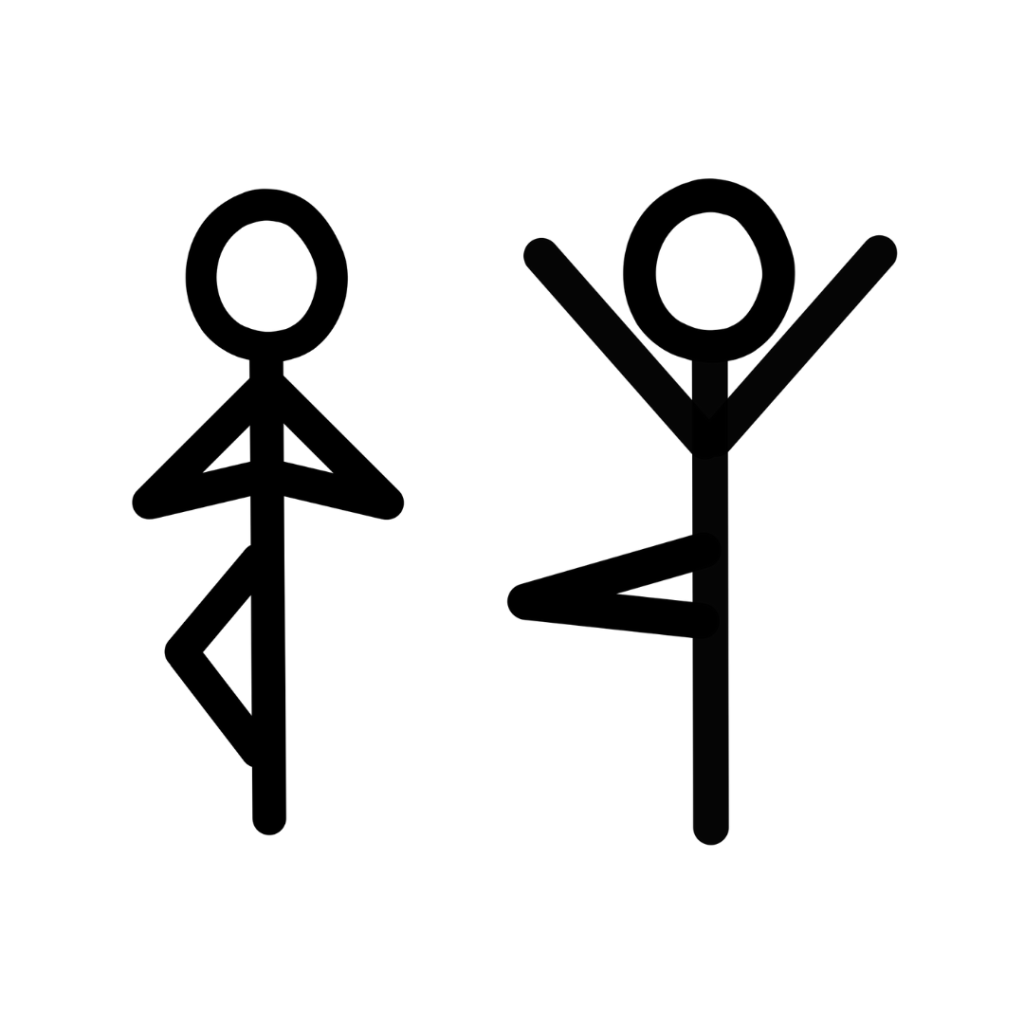
I love tree pose as a way to calm the body and mind because it takes focus to find your balance. When I feel a bit all over the place, I practice balancing poses in yoga to help ground myself and focus my energy. By practicing tree pose, we use that image of actually rooting down like the roots of a tree and feeling support from the ground beneath us. We find our Drishti – that focus point on the wall in front of us so we can balance more easily. If we are looking around all around us, trying to see what others are doing then we are going to find it harder to do what we are trying to do, much like in life. By having our focus point we can choose to stay grounded and present as we create balance not just in our body but in our mind.
Practicing tree pose with children who are struggling to calm down provides a great physical practice while also helping calm the mind.
You can also try tree pose variations. Have you tried tree pose together? What about laying down?
7. Bumble Bee Breathing
As a yoga teacher and a parent, I highly recommend incorporating bumblebee breath into your child’s yoga practice. This breathing technique, also known as Bhramari Pranayama, has numerous benefits for the mind and nervous system.
When practicing bumblebee breath, children are encouraged to take deep, slow breaths while making a humming sound. This sound creates a vibration throughout their body, which can help calm the mind and reduce stress and anxiety. The controlled breathing also helps to regulate the nervous system, which can be especially helpful for children who struggle with attention or hyperactivity.
Additionally, the sound of the humming can be very soothing for children, and can help them feel more grounded and present in their bodies. This can be particularly helpful during times of stress or anxiety, such as before a big test or when dealing with a difficult situation at home.
I recommend practicing bumblebee breath for a few minutes each day, either as part of a larger yoga practice or as a standalone technique. Encourage your child to focus on their breath and the vibration of the humming, and to take their time with each inhale and exhale. With regular practice, they will likely begin to notice a greater sense of calm and relaxation in their daily life.
There you have it!
7 of my families’ favourite yoga practices for helping us all to calm down!
Want more calm in your life?
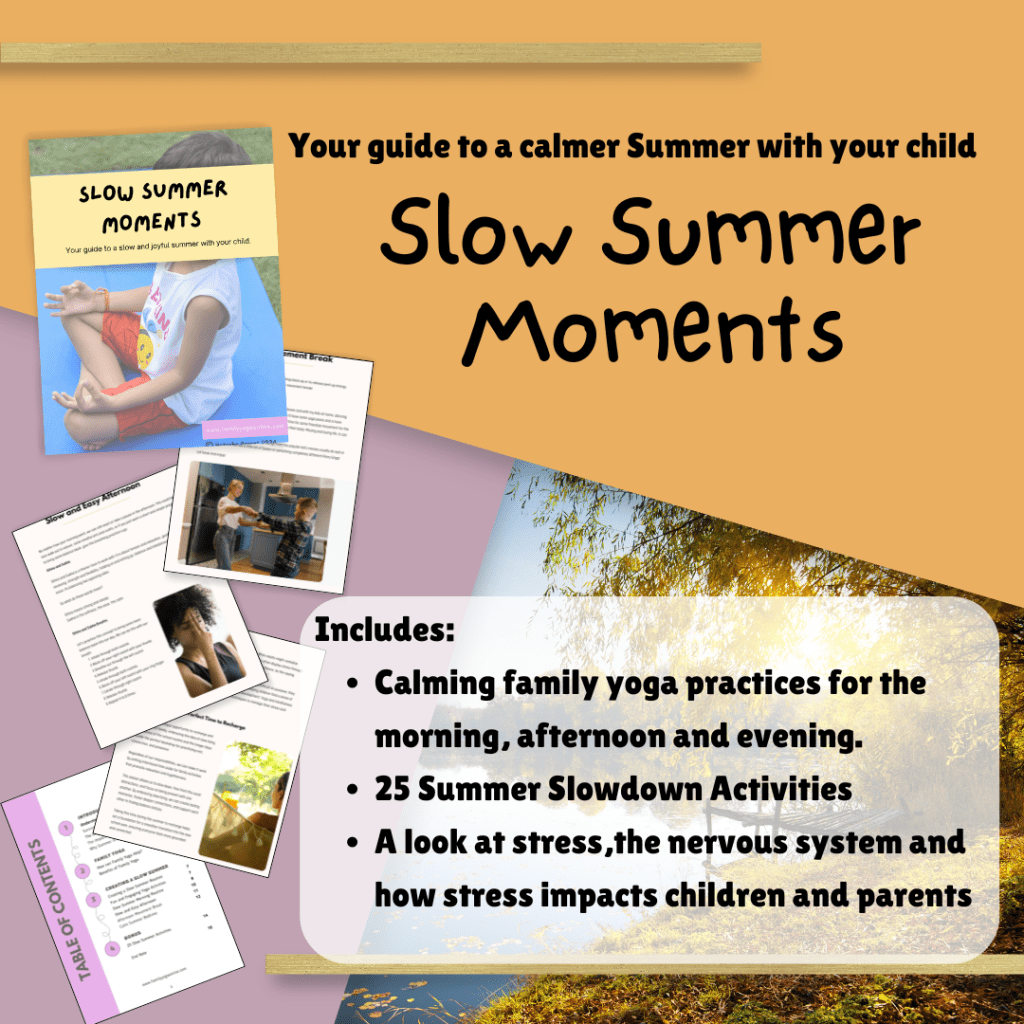
Check out my new guide: Slow Summer Moments
The 10‑Minute Bedtime Bridge That Transforms Chaotic Evenings into Calm
Because stressful nights don’t need to end in battles (or guilt). Real Talk: Messy Bedtimes Happen Let’s be honest… I am not the mum who has her evenings perfectly organised, where the kids calmly go to bed at 7 p.m. and I get this magical “me time” after. Nope. Sometimes it’s 9 p.m. and no one’s in…

I don’t always want to practice Yoga with my Children
This might surprise you, especially coming from someone who talks about yoga together sooo much, but I don’t always want to practice yoga with my children. And sometimes… they don’t want to practice with me either. The other day, I rolled out my mat ready for my own practice. And like a moth to a…
Why “Just Take a Deep Breath” Often Doesn’t Work (And What Actually Helps)
“Take a deep breath.” It’s one of the most common pieces of advice we hear…. to support children and ourselves, told to anyone who looks overwhelmed, angry or having a tough time. And while it’s usually said with care, compassion, and good intention… it so often falls flat. You’ve probably seen it.You suggest a deep…
 Family Yoga with Natasha
Leave a comment