
5 Things Yoga Has Taught Me About Emotional Regulation
Emotional regulation isn’t about controlling or suppressing emotions—it’s about learning to ride the waves, understanding what’s beneath them, and finding ways to support ourselves through them.
Yoga has been one of my greatest teachers in this, not just on the mat but in everyday life. Here are five powerful lessons yoga has taught me about emotional regulation.
1. Feeling My Emotions Instead of Suppressing Them
Yoga encourages us to notice what we feel—physically, mentally, and emotionally—without judgment. Instead of brushing off emotions with “I’m fine” or “it wasn’t that bad,” I’ve learned to pause and ask myself: What am I actually feeling? As someone who has often just ‘got on with it’ and downplayed my own feelings, this has been challenging at times but it has been so freeing too.
I can remember actually apologizing for being sick and in pain. I felt like such a burden. I felt like I had to pretend that I was okay so that I didn’t…. I don’t know…..take up too much space? Annoy them? Bring the mood down? It didn’t come out of no where. You see I struggled after a major operation and would get such bad pain flair ups from adhesions and my partner at the time would find this very inconvenient. Things like this make us hide our physical, emotional and mental pain.
I’m sure you have stories too where you felt something and it was completely brushed off, right?
In a world that often teaches us to push our feelings and emotions aside, yoga has given me permission to sit with them, to breathe through them, and to honour their presence rather than forcing them away.
2. Emotional Regulation is Layered—Just Like the Koshas
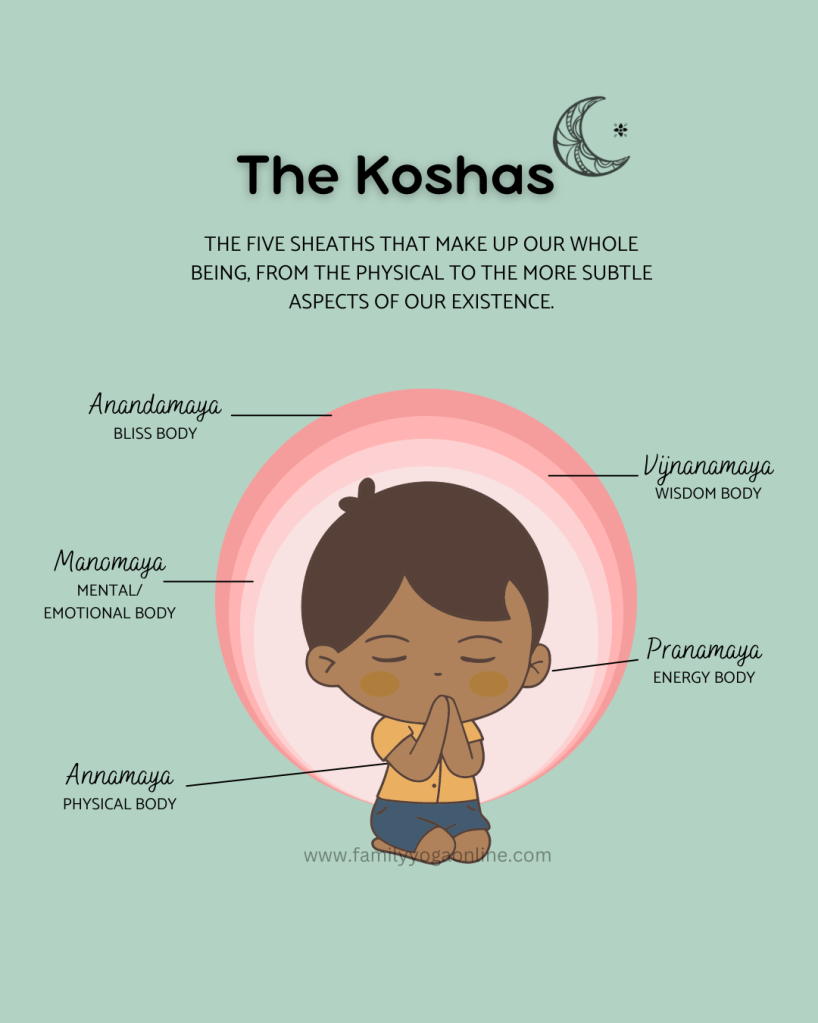
In yoga philosophy we learn about the koshas (layers of being). Understanding the Koshas….
- Annamayakosha (Physical Body)
- Pranamayakosha (Energy Body)
- Manomayakosha (Mental / Emotional Body)
- Vijnanamayakosha (Wisdom Body)
- Anandamayakosha (Bliss Body)
….has completely reshaped how I see emotional regulation. These five layers remind me that emotions don’t exist in isolation.
- Some days, stress shows up in my body (a tight jaw, tense shoulders, stomach pain, headaches).
- Other times, it’s my breath (short, shallow, rushed).
- Or maybe it’s my mind (overthinking, spiraling thoughts).
Understanding the koshas helps me check in with myself at different levels, knowing that balance isn’t just in my head—it’s in my entire being.
To learn more about the Koshas check out this previous post: What are the Koshas? Understanding these 5 layers will help support your families well-being!
3. Making Space for Gratitude (Instead of Rushing Past It)
We tend to notice difficult emotions because they demand attention. But what about joy? Contentment? Gratitude?
Yoga’s principle of Santosha (contentment) has taught me to stay in gratitude a little longer. Instead of feeling grateful for a fleeting second before moving on to the next thing, I let myself soak in the moment, even if it means returning to it later on when I have my journal out and almost re-living it.
Practices like journaling, mindfulness, and even placing a hand on my heart while I reflect on something good help me hold onto gratitude a little longer.
4. The Breath is My Anchor (Always!)
One of the most practical tools yoga has given me for emotional regulation is my breath. It’s always there, always accessible, and always a direct pathway to calm.
When emotions feel overwhelming, simple breathwork—like extending my exhales or practicing Bee Breath (Bhramari)—helps shift my nervous system from fight-or-flight into a more balanced, regulated state.
Just the other night, my head hit the pillow and I felt this immense feeling of gratitude and joy – I was so tired and bed was definitely my favourite place to be. But then, my brain went oh no you don’t! I suddenly started having these horrible worrying thoughts, my mind started running away with an elaborate story and my heart started to race. I noticed my anxiety was taking over and so I began a practice that always helps me. I simply say – I am breathing in, I am breathing out. This helps me to focus on my breath as an anchor, letting go of that dramatic story in my mind and coming back to me telling my body – You are safe.
And when I practice these things with my children? It’s like sharing a powerful tool for the future as well as sharing calm in the moment. The more we practice together, the more accessible these practices are going to become in more challenging moments.
You can find my workshop that deep dives into supporting children with breathwork here.
5. Emotional Regulation is a Practice, Not a Destination
Yoga has taught me that regulation isn’t about getting rid of big emotions—it’s about learning to meet them with awareness and compassion. Some days, I feel completely grounded. Other days, I don’t. And that’s okay.
The key is in coming back—to my breath, my body, my emotions, and my practices. Because emotional regulation isn’t about achieving some perfect state of calm; it’s about knowing how to support myself (and my children) through the ups and downs of life.
Yoga is a Roadmap
Yoga isn’t just about poses—it’s a roadmap for understanding and working with emotions in a deeply supportive way. Through movement, breath, awareness, and yoga philosophy, I’ve learned to notice, honour, and navigate my emotions with more ease.
Free Family Emotional Regulation Toolkit
A simple, actionable bundle of tools to help your family regulate emotions, manage stress, and find calm together—even on the hardest days.
Download Your Free Bundle Here
What’s one yoga or mindfulness practice that has made a big difference in how you handle stress? Comment Below

Transform Bedtime into a Cosy Family Ritual
Do you dread the nightly battle to get your child to bed? Instead of chaos and resistance, imagine a peaceful transition that leaves everyone feeling connected and calm. This isn’t just about getting your child to sleep; it’s about creating a special, relaxing time that you can enjoy together. You can swap those stressful evenings…

The 10‑Minute Bedtime Bridge That Transforms Chaotic Evenings into Calm
Because stressful nights don’t need to end in battles (or guilt). Real Talk: Messy Bedtimes Happen Let’s be honest… I am not the mum who has her evenings perfectly organised, where the kids calmly go to bed at 7 p.m. and I get this magical “me time” after. Nope. Sometimes it’s 9 p.m. and no one’s in…
I don’t always want to practice Yoga with my Children
This might surprise you, especially coming from someone who talks about yoga together sooo much, but I don’t always want to practice yoga with my children. And sometimes… they don’t want to practice with me either. The other day, I rolled out my mat ready for my own practice. And like a moth to a…
Latest Posts:
 Family Yoga with Natasha
Leave a comment