
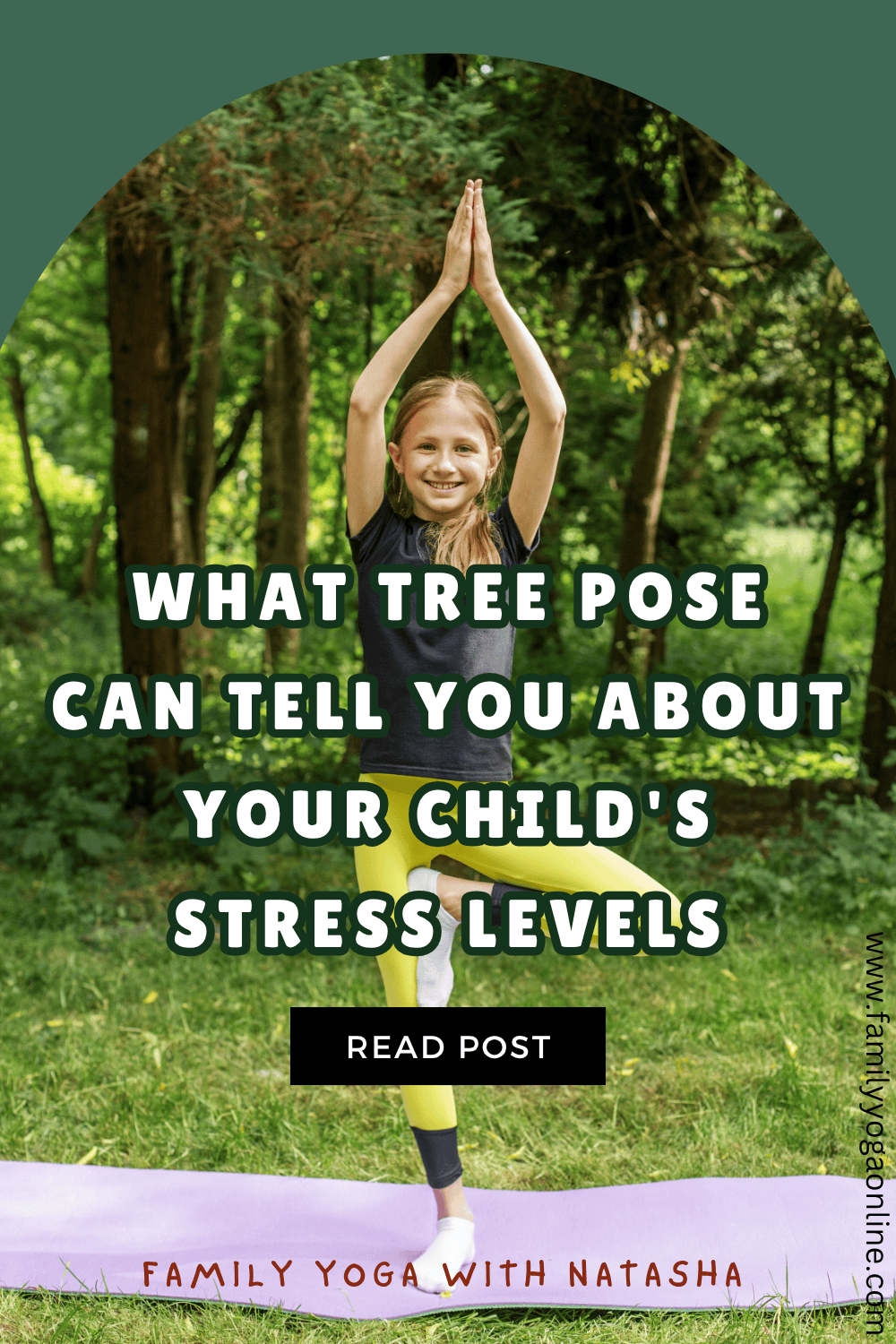
Have you ever noticed that some days your child can stand in Tree Pose with ease, and other days they can’t stop wobbling, fidgeting, or falling over?
There’s a reason I love balancing poses in family yoga.
They give us an opportunity to slow down, notice what’s happening in our bodies, and explore how we’re feeling….without needing to find all the right words.
And one of my favourite poses for this is Tree Pose. 🌳
Because sometimes, when we invite children to balance, we get a little glimpse of what’s going on beneath the surface.
What a wobbly Tree Pose might be telling you
Imagine asking your child to stand on one leg, place their other foot against their standing leg, and grow their branches like a tree.
Some days, they’re steady and focused.
Other days, it’s a completely different story!
You might notice:
- Their eyes darting around the room.
- Lots of fidgeting, wobbling, or repeatedly toppling over.
- Rushing in and out of the pose, or adding extra movement by hopping, spinning, or being silly.
- The opposite: a stiff, tense body, with shoulders creeping up towards their ears.
- Frustration when they can’t get the pose to work the way they want.
Now, let’s be clear. None of these things automatically means your child is stressed or dysregulated. They might be tired, excited, distracted, developing their balance skills, or simply in a playful mood.
But they give us something interesting to explore.
Rather than judging the wobble, we can get curious about it.
Because the goal isn’t to create the perfect tree.
It’s to help our children notice what’s happening in their bodies, discover what supports them, and learn that they can adjust when something feels challenging.
Why balancing poses are such a valuable practice
1. They invite us into the present moment
Try balancing on one leg while thinking about five different things at once!
It’s not easy, is it?
A balancing pose invites children to bring their attention to what’s happening right now: their feet, their posture, their breathing, and the tiny adjustments their bodies are making.
For a child whose mind feels busy, this can offer a simple, practical opportunity to practise focusing their attention.
We’re not demanding that they empty their minds or sit perfectly still.
We’re giving their attention somewhere to land.
2. They give the mind something to focus on
In yoga, we sometimes use a focal point for the gaze, called drishti.
For Tree Pose, that might mean choosing a spot on the wall or a mark on the floor.
You can invite your child to find their own special tree-watching spot.
“Can you find one place for your eyes to rest?”
“Does it feel different when you look at one spot instead of looking all around?”
Sometimes a little focus makes a big difference.
And if your child is still wobbling? That’s absolutely fine. The practice isn’t a test!
3. They teach us that support is a good thing
This is one of my favourite lessons in Tree Pose.
We don’t have to balance all by ourselves.
We can hold a wall.
We can use a chair.
We can hold a parent’s hand.
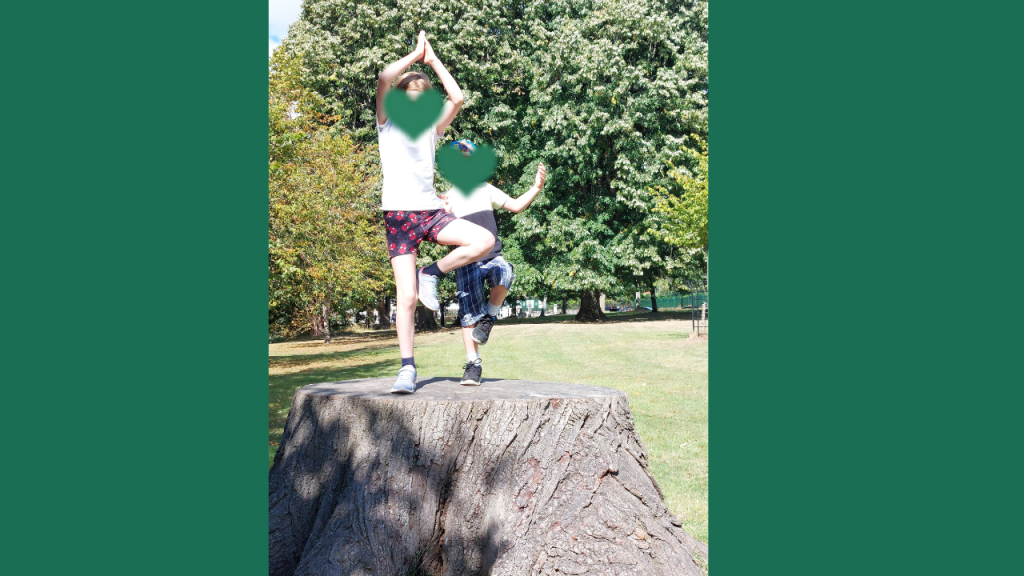
We can even practice partner Tree Pose, standing side by side and leaning gently towards one another for support.
I love this because it opens up a much bigger conversation:
“What support do I need right now?”
That’s a useful question for children and grown-ups alike.
Sometimes we need to try something independently. Sometimes we need a little help. Sometimes we need to change the plan completely.
Learning to recognise that we need support isn’t failure. It’s awareness.
4. They help children practice responding to challenge
Let’s face it: trees wobble!
They sway in the wind. Their branches move. Sometimes they lean a little too far and need to find their balance again.
And that’s exactly what makes this pose so lovely.
Children get to wobble, fall, laugh, try again, and discover that they don’t have to get it right the first time.
We can model this too.
“Oh, my tree fell over! I wonder what might help me feel steadier?”
Maybe it’s focusing their gaze. Maybe it’s placing a hand on the wall. Maybe it’s bringing their foot lower down the standing leg.
Or maybe today isn’t the day for balancing on one leg, and they’d rather be a tree with both feet firmly planted on the ground.
That’s yoga, too.
We’re practicing flexibility in how we respond to challenges…not just flexibility in our bodies.
🌳 Try Tree Pose together
Here’s a simple way to explore this at home.
Step 1: Grow your trees.
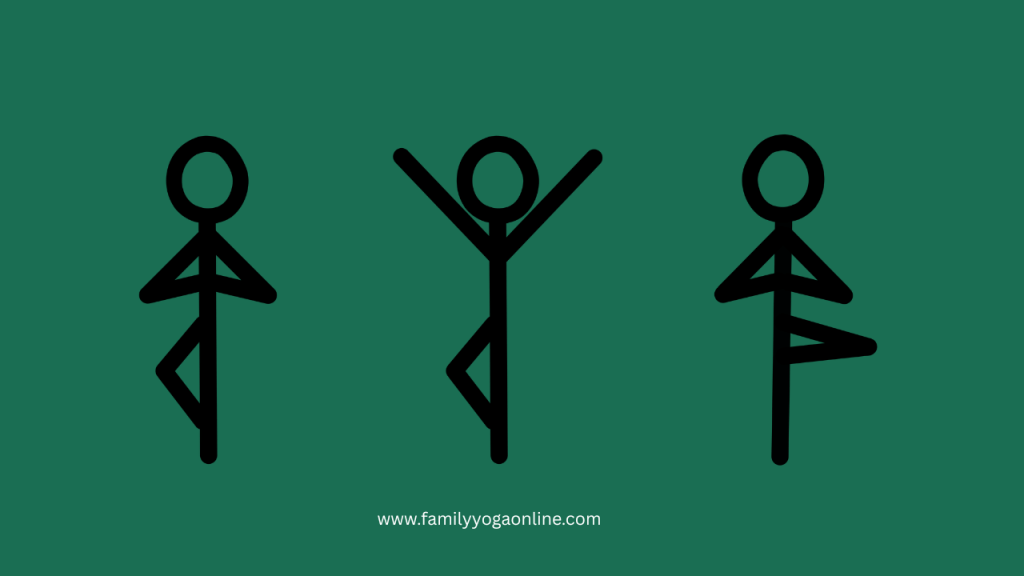
Stand side by side with your feet planted on the ground. Take a moment to feel your feet connecting with the floor.
Step 2: Find your balance.
Shift your weight onto one foot and bring the other foot to your ankle or calf. You can keep your toes on the floor for extra support. Avoid pressing your foot directly against the knee.
Step 3: Choose your support.
Would a wall, a chair, or a parent’s hand help? There’s no prize for balancing without support!
Step 4: Find your focus.
Choose one spot for your eyes to rest. Imagine your roots growing down into the earth and your branches reaching towards the sky.
Step 5: Notice what happens.
Does your tree feel steady? Wobbly? Strong? Tired? Playful?
There’s no right or wrong answer. You’re simply noticing.
Then swap sides and see whether the other tree feels different!
💬 The conversation that matters most
Once you’ve finished, you might ask your child:
✨ “How did your tree feel today?”
✨ “Was it wobbly or steady?”
✨ “What helped you balance?”
✨ “Did you want to do it by yourself, or did you like having some support?”
✨ “Would you like to try it differently next time?”
You don’t need to ask all these questions, and you don’t need to turn your yoga practice into an interview!
Sometimes one gentle question is enough. And sometimes your child won’t want to talk about it at all. That’s fine, too.
Children can find it easier to share thoughts and feelings when we’re doing something alongside them rather than sitting opposite them and asking direct questions.
The most important thing is that we create space for curiosity, without making assumptions about what their movements mean.
We’re not trying to interpret every wobble. We’re helping children learn to notice themselves.
And that is a beautiful skill to practice.

Want to explore more family yoga together?
Inside the Family Yoga Club, we take simple poses like Tree Pose and turn them into playful, meaningful opportunities for connection, body awareness, and emotional regulation.
You’ll find yoga games, themed sequences, mindfulness, sensory-based practices, and simple tools to explore together as a family.
Tomorrow, I’m sharing a beautiful Autumn Leaf Sequence as our Practice of the Week! 🍂
And remember, we have a Practice of the Week rather than a Practice of the Day for a reason. There’s no need to squeeze another daily task into an already busy family life. You can return to a practice, explore it in different ways, and find what works for you.
If you’d like practical ways to support your children through big feelings while building more moments of connection, come and join us.
💛 You can explore the Family Yoga Club free for 7 days and then decide if you’d like to stay.
Join the Family Yoga Club here
Let’s build connection habits, one playful practice at a time. 🌿
Do you know what really annoys me about kids breathing practices being shared??
I shared about this yesterday on Instagram , but it’s SUPER ANNOYING so there is more to be said 😂 I’ve spent an obsessively long time studying the breath – understanding it physically like the anatomy of the breath, the autonomic nervous system and how breath can be used as a regulatory tool and…


Transform Bedtime into a Cosy Family Ritual
Do you dread the nightly battle to get your child to bed? Instead of chaos and resistance, imagine a peaceful transition that leaves everyone feeling connected and calm. This isn’t just about getting your child to sleep; it’s about creating a special, relaxing time that you can enjoy together. You can swap those stressful evenings…
The 10‑Minute Bedtime Bridge That Transforms Chaotic Evenings into Calm
Because stressful nights don’t need to end in battles (or guilt). Real Talk: Messy Bedtimes Happen Let’s be honest… I am not the mum who has her evenings perfectly organised, where the kids calmly go to bed at 7 p.m. and I get this magical “me time” after. Nope. Sometimes it’s 9 p.m. and no one’s in…


Leave a Reply