Overview of the Koshas
As I sat on my yoga mat, using my bolster for extra support, my fingers forming a mudra, I reflected on the journey of my practice. Just moments ago, my mind had been scattered and restless, making each pose feel like a struggle. Yet, here I was, feeling completely peaceful and centered.
This transformation didn’t happen by chance; it was the result of working with the different layers of my being, known as the Koshas.
Imagine the Koshas as Russian nesting dolls, each layer encapsulating the one within it. These layers are not just physical; they extend beyond the body, encompassing various aspects of our existence. Just as a small cup fits into a larger one, the Koshas interconnect, each influencing the next to create a holistic sense of well-being.
Understanding the Koshas isn’t just about delving into yoga philosophy; it’s about uncovering a practical framework that can profoundly impact our well-being and that of our children.
While children may not grasp the intricacies of each Kosha, we, as parents and caregivers, can harness the power of these layers to support their growth and emotional resilience.
The Five Koshas
The Koshas are like layers or sheaths that make up our whole being, from the physical to the more subtle aspects of our existence. Here’s a simple breakdown:
- Annamayakosha (Physical Body)
- Pranamayakosha (Energy Body)
- Manomayakosha (Mental / Emotional Body)
- Vijnanamayakosha (Wisdom Body)
- Anandamayakosha (Bliss Body)
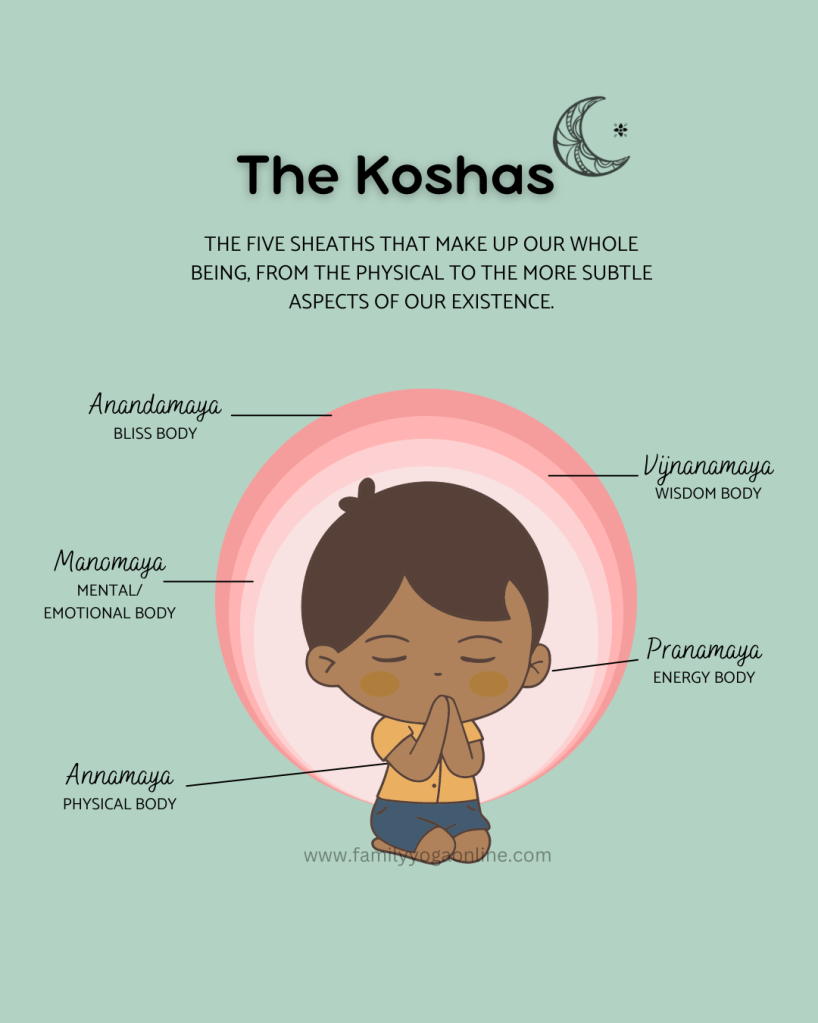
We will dive into each of these Koshas a little bit more each week. This week I want to share with you a little more about Annamayakosha.
Dive into Annamayakosha (Physical Body)
This is the outermost layer and represents our physical body—the bones, muscles, organs, and everything else you can see and touch. It’s the part of us that interacts with the physical world.
When we work with this layer, we’re not just focusing on physical movement or exercise (although that is a great start and why we often start with yoga poses for children). It’s about fostering a deeper connection with the body—an awareness of sensations, movements, and the signals it sends us. By encouraging children to tune into their bodies, we empower them to recognize and respond to their needs more effectively. This cultivates mindfulness and presence, teaching them to be in the moment and make conscious choices that support their well-being.
Moreover, nurturing this connection with the physical body promotes self-care practices from a young age. Children learn to listen to their bodies’ cues, whether it’s hunger, fatigue, or discomfort, and respond with kindness and care.
This fosters a sense of self-acceptance and self-love, as they come to appreciate and respect their bodies for all they can do. Ultimately, by understanding and honouring Annamayakosha, we lay the groundwork for children to grow into adults who prioritize their physical and emotional health, leading to a more balanced and fulfilling life.
A time I was so disconnected from my body…
I used to be completely disconnected from my body. So much that when I was in the worse pain of my life at 17 years old – when a doctor said “Take some paracetamol and drink some cranberry juice and you’ll be fine.” I believed them over what my body was telling me. Sure, they are the expert right?
Had I listened to my body, I would have gone straight to the hospital. Here’s what I did instead.
I got a taxi into work. It was only up the hill but I couldn’t walk at all. I was hunched over in pain… I wanted them to see I was in pain and not faking being sick. I was so pale and felt like I was going to collapse. I waited for the head chef to show up, told them I didn’t think I could work, and then got a 2 minute taxi back down the hill and then I was taken to the doctors.
That evening I was much worse. The cranberry juice and paracetamol were surprisingly doing nothing and I was blacking out with the pain. Had my dad asked me if I wanted an ambulance, I would have said no. I’m sure the doctor knows what they are talking about, I’ll be okay.
Had my dad waited until the morning, I wouldn’t be here now. It was that serious.
Even when I was in the hospital I was apologizing to the nurses as I just felt like a burden – I was in so much pain. After having the surgery it was a long recovery, learning how to walk again and even having someone come round to try and get me breathing right (which at the time I did not see the benefit of 🙈).
When I was finally able to go home I still had a long way to go with my recovery. This all happened at the very start of the Summer holidays and then September came and it was time to go back to school. I was half way through my A levels and had 4 subjects. I went in and I can remember feeling like I was going to have a massive panic attack. I couldn’t breath, I was exhausted and it all felt too much.
This time I actually did listen to my body and ask for what I needed! I decided to talk to the people in the office and ask them if I could come in a few times a week and do the majority of my work at home, just while I am recovering. They told me absolutely not, they don’t have time for that. And that was that.
Bringing it all back
Recognizing the significance of Annamayakosha—the physical body—is a journey I’ve personally embarked on, later than I wish I had. For years, I ignored the subtle cues and signals my body sent me, pushing through exhaustion, discomfort, and stress without a second thought. It wasn’t until I discovered the transformative power of yoga that I began to truly understand the importance of listening to my body and honouring its needs.
Now, as a parent and yoga teacher, I’m passionate about imparting this wisdom to our children from an early age. Children are naturally attuned to their bodies; they instinctively know when they’re hungry, tired, or in need of comfort. By fostering a deeper connection with their physical selves through yoga and mindfulness practices, we empower them to become the masters of their own bodies, for that is what they truly are.
Through simple yet profound techniques, I guide children to tune into their bodies’ cues, teaching them to listen, respect, and care for themselves. By instilling these practices early on, we equip them with invaluable tools for navigating life’s challenges with grace and resilience.
Join me next week as we delve deeper into the energetic body—the Pranamayakosha—and explore how understanding and nurturing this layer can further support our children’s holistic well-being.
Until then, may you continue to honour and cherish the wisdom of your physical body, and may it guide you on your journey toward greater health and vitality.
Comment below with a ❤️ if you found this post helpful and looking forward to diving more into the Koshas!
Next post: The Kosha Series – An introduction to Pranamayakosha
The 10‑Minute Bedtime Bridge That Transforms Chaotic Evenings into Calm
Because stressful nights don’t need to end in battles (or guilt). Real Talk: Messy Bedtimes Happen Let’s be honest… I am not the mum who has her evenings perfectly organised, where the kids calmly go to bed at 7 p.m. and I get this magical “me time” after. Nope. Sometimes it’s 9 p.m. and no one’s in…


I don’t always want to practice Yoga with my Children
This might surprise you, especially coming from someone who talks about yoga together sooo much, but I don’t always want to practice yoga with my children. And sometimes… they don’t want to practice with me either. The other day, I rolled out my mat ready for my own practice. And like a moth to a…

Why “Just Take a Deep Breath” Often Doesn’t Work (And What Actually Helps)
“Take a deep breath.” It’s one of the most common pieces of advice we hear…. to support children and ourselves, told to anyone who looks overwhelmed, angry or having a tough time. And while it’s usually said with care, compassion, and good intention… it so often falls flat. You’ve probably seen it.You suggest a deep…

 Family Yoga with Natasha
Leave a reply to The Anandamaya Kosha – Bliss Body (Kosha series 5/5) – Family Yoga with Natasha Cancel reply